Real Guidance. Real Support. A Successful Study Abroad Journey.
Choosing the best country to study abroad is one of the most important decisions for Bangladeshi students planning to build an international career. The right destination can offer quality education, globally recognised degrees, scholarship opportunities, part-time work options, and potential career pathways after graduation.
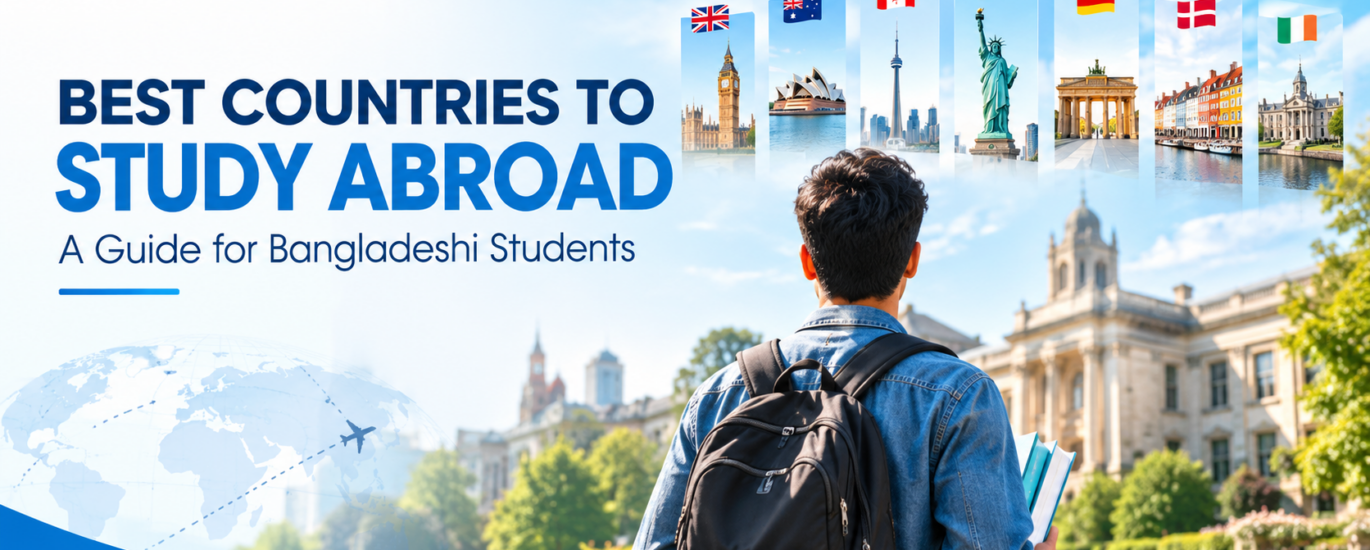
Popular destinations include the United Kingdom, Australia, Canada, the United States, Germany, Denmark, and other European countries. However, the best country depends on your academic background, budget, chosen subject, English proficiency, and long-term career goals.
In this guide, we explore the best countries to study abroad for Bangladeshi students in 2026, comparing tuition fees, living expenses, scholarships, popular courses, and important factors to consider before applying.
What Are the Best Countries to Study Abroad for Bangladeshi Students?
The best countries to study abroad for Bangladeshi students include the UK, Australia, Canada, the USA, Germany, and Denmark. The UK is popular for shorter master’s degrees, Australia offers diverse academic and career opportunities, Germany attracts students interested in technical education, and the USA provides a wide range of programmes and research opportunities.
The right choice depends on your financial resources, preferred course, university admission requirements, and current student visa regulations.
1. United Kingdom (UK)
The United Kingdom is a leading destination for Bangladeshi students because of its internationally recognised universities, diverse academic programmes, and relatively short postgraduate courses.
Many UK universities offer one-year master’s degrees, allowing eligible students to complete their postgraduate education in less time than in countries where master’s programmes commonly take two years.
Why Should Bangladeshi Students Choose the UK?
- Globally recognised universities and qualifications.
- Many master’s programmes can be completed in one year.
- A wide range of courses in business, law, computing, engineering, healthcare, and social sciences.
- Scholarships and university-specific tuition discounts for eligible international students.
- Opportunities to gain international academic and professional experience.
Popular Courses in the UK
- Business Management and International Business
- Law and International Relations
- Computer Science and Data Science
- Cybersecurity and Artificial Intelligence
- Public Health and Healthcare Management
- Engineering and Digital Marketing
Tuition Fees and Living Costs
International tuition fees vary significantly by university, subject, and qualification. As a broad planning estimate, undergraduate and postgraduate tuition may range from £11,000 to £30,000 or more per year. Living expenses depend on the city, accommodation, and personal lifestyle.
London is generally more expensive than many other UK cities. Students should calculate the full cost of tuition, accommodation, food, transportation, visa fees, and other expenses before applying.
Who Should Choose the UK?
Study in UK may suit Bangladeshi students who want a recognised international degree, a wide selection of academic programmes, and a shorter master’s route. Students should verify the current Graduate visa rules and university eligibility before making a decision.
2. Australia
Australia is another popular study destination for Bangladeshi students, offering internationally recognised qualifications, multicultural communities, and universities with strong programmes in technology, business, engineering, health, and research.
Why Study in Australia?
- Recognised universities and practical learning opportunities.
- A broad selection of undergraduate and postgraduate programmes.
- Scholarships offered by universities and other eligible providers.
- Opportunities to develop professional skills through eligible work arrangements.
- A multicultural environment for international students.
Popular Courses in Australia
- Information Technology and Computer Science
- Nursing and Public Health
- Engineering
- Accounting and Finance
- Business Administration
- Environmental Science
Tuition Fees and Living Costs
As a general planning estimate, international tuition fees may range from AUD 20,000 to AUD 50,000 or more per year. Living expenses vary depending on the city and accommodation arrangements.
Students should check Australia’s current student visa financial requirements, permitted work conditions, health insurance requirements, and post-study work eligibility before applying.
Who Should Choose Australia?
Australia may be a good choice for students seeking practical education, a diverse student community, and potential post-study career opportunities, provided their chosen course and circumstances meet the relevant requirements.
3. Canada
Canada has attracted Bangladeshi students interested in internationally recognised qualifications, research, technology, business, and career development. However, students must carefully review Canada’s changing international student policies before selecting a college or university.
Benefits of Studying in Canada
- A range of universities and colleges offering different qualifications.
- Programmes in technology, business, engineering, healthcare, and research.
- Scholarship opportunities for eligible students.
- Multicultural cities and international student communities.
- Potential post-graduation work opportunities for graduates who meet current eligibility criteria.
Popular Courses in Canada
- Computer Science and Software Engineering
- Data Analytics and Artificial Intelligence
- Business and Supply Chain Management
- Engineering
- Public Health
- Finance and Accounting
Tuition Fees and Living Costs
International tuition fees can vary widely, with a broad planning range of CAD 15,000–40,000 or more annually for many programmes. Living costs depend on the province, city, and accommodation type.
Before paying a deposit, check whether the institution and programme meet the current study permit and post-graduation work permit requirements. Not every programme automatically qualifies for a post-graduation work permit.
Who Should Choose Canada?
Study In Canada may suit students looking for programmes in technology, research, business, or other professional fields. It is particularly important to compare total costs and verify the latest immigration rules rather than relying on older advice.
Read Our Post to Know More: UK vs Canada vs Australia: Which Destination Is Better for International Students in 2027?
4. United States (USA)
The United States is an attractive destination for students seeking academic flexibility, advanced research facilities, and a wide range of universities. It offers opportunities across undergraduate, postgraduate, and doctoral education.
Why Study in the USA?
- A large selection of universities and specialised programmes.
- Strong research facilities in many academic fields.
- Scholarship, assistantship, and funding opportunities at eligible institutions.
- Flexible academic options at some universities.
- Opportunities to develop professional and research skills.
Popular Courses in the USA
- Computer Science and Artificial Intelligence
- Data Science and Analytics
- Engineering
- Business Administration and MBA
- Biotechnology and Life Sciences
- Economics and Finance
Tuition Fees and Living Costs
Costs vary considerably by institution and location. As a broad planning estimate, international tuition may range from USD 20,000 to USD 60,000 or more annually. Accommodation, health insurance, food, transportation, and other expenses must also be considered.
Some universities offer merit-based scholarships, research assistantships, or teaching assistantships, particularly for eligible postgraduate students. Funding is competitive and should never be assumed without an official offer.
Who Should Choose the USA?
The USA may be suitable for students prioritising research, specialised academic programmes, and a broad range of university options who can develop a realistic funding plan.
5. Germany
Germany is an important destination for students interested in engineering, technology, research, and scientific education. Some public universities charge no general tuition fees for certain programmes, but exceptions and semester contributions apply.
Benefits of Studying in Germany
- Strong academic and research traditions.
- Many programmes in engineering, technology, and scientific fields.
- Some public universities offer tuition-free study for eligible programmes and students.
- Opportunities to learn German and develop international professional skills.
- Scholarships and research funding for eligible applicants.
Popular Courses in Germany
- Mechanical and Electrical Engineering
- Computer Science
- Renewable Energy
- Automotive Engineering
- Data Science
- Natural Sciences
Tuition Fees and Living Costs
Tuition arrangements depend on the university, state, degree, and student category. Some institutions charge tuition fees, and all students should account for semester contributions and living expenses.
Students must also demonstrate the required financial resources for their visa, meet the programme’s language requirements, and check whether their qualifications are recognised for admission.
Who Should Choose Germany?
Germany may be a strong option for students interested in technical subjects and research who are comfortable navigating programme-specific admission requirements and, where necessary, learning German.
6. Denmark
Denmark offers an international learning environment and programmes in areas such as engineering, sustainability, business, design, and technology. It can be worth considering for students looking for a European study destination.
Why Consider Denmark?
- Internationally oriented universities and programmes.
- Opportunities to study sustainability, engineering, and technology.
- A strong focus on independent learning and practical projects in many programmes.
- Scholarships available to eligible students through selected institutions and schemes.
- Exposure to European academic and professional environments.
Popular Courses in Denmark
- Renewable Energy and Sustainability
- Engineering
- Business and Management
- Computer Science and Information Technology
- Design and Innovation
- Environmental Science
Tuition Fees and Living Costs
Non-EU/EEA students generally pay tuition fees for higher education in Denmark, although exemptions and scholarships may apply. Living expenses can be relatively high, particularly in major cities.
Bangladeshi applicants should confirm the programme’s language of instruction, tuition fees, scholarship conditions, and current residence permit requirements directly with the institution and Danish authorities.
Who Should Choose Denmark?
Denmark may suit students interested in specialised European programmes, sustainability, technology, or innovative learning environments who have a sufficient budget or suitable funding.
7. Ireland
Ireland is another option for Bangladeshi students interested in technology, business, pharmaceuticals, finance, and other internationally oriented fields.
Benefits of Studying in Ireland
- English-language programmes at many institutions.
- Courses in technology, business, science, and healthcare-related fields.
- International student communities.
- Scholarships offered by selected universities and institutions.
- Potential graduate employment pathways subject to current eligibility rules.
Popular Courses in Ireland
- Computer Science and Software Development
- Pharmaceutical Science
- Business Analytics
- Finance and Accounting
- Data Science
- Engineering
Tuition fees and accommodation costs vary by course and institution. Students should compare the full annual budget and check current student work and graduate permission rules before committing to a programme.

“As a Bangladeshi student, I found it difficult to choose the right country for my higher education. Comparing tuition fees, courses, and scholarship opportunities helped me understand which destination suited my goals and budget.”
Mr. Sharuz ( MA in UK)
Comparison of the Best Countries to Study Abroad
The following table provides a starting point for Bangladeshi students comparing popular destinations. All cost ranges are indicative estimates, not official quotations or guaranteed minimum budgets.
Country | Main attractions | Indicative annual tuition | Best suited for |
UK | Short master’s degrees, broad course selection | £11,000–£30,000+ | Business, law, computing, healthcare |
Australia | Practical learning, diverse programmes | AUD 20,000–50,000+ | IT, nursing, business, engineering |
Canada | Research, technology, varied institutions | CAD 15,000–40,000+ | Computing, business, engineering |
USA | Research, university choice, specialised study | USD 20,000–60,000+ | STEM, business, research |
Germany | Technical education, selected low-tuition options | Varies by institution and state | Engineering, science, technology |
Denmark | Sustainability, innovation, European education | Varies by programme | Engineering, design, sustainability |
Ireland | English-language education, technology sector | Varies by institution | IT, business, pharmaceuticals |
Important: Tuition fees, living costs, scholarship availability, visa conditions, and graduate work permissions change. Always check the official university and government websites for your intended intake.
Which Country Is Best for Bangladeshi Students on a Budget?
There is no single cheapest country for every Bangladeshi student. The most affordable destination depends on tuition fees, scholarships, accommodation, travel, insurance, exchange rates, and proof-of-funds requirements.
Consider these options:
- Germany: Investigate eligible public universities with low or no general tuition fees, while budgeting for living expenses and any applicable fees.
- UK: Compare one-year master’s programmes and scholarship opportunities to assess the total cost of a shorter degree.
- Canada: Compare universities and eligible programmes carefully, including living expenses and current study permit requirements.
- Denmark: Investigate scholarships and institutional funding, as non-EU/EEA tuition and living expenses can be substantial.
- USA: Research university scholarships and graduate assistantships before deciding whether a programme is financially viable.
A lower tuition fee does not necessarily mean a lower total cost. Students should calculate the entire study period and ensure they can meet the required financial evidence rules.
Which Country Is Best for Scholarships?
Scholarship availability depends on academic performance, chosen subject, level of study, nationality, and individual university policies.
Bangladeshi students can explore:
- University merit-based scholarships in the UK, Australia, Canada, the USA, Ireland, and Denmark.
- Government-funded international scholarship schemes where Bangladesh is an eligible country.
- Research funding and assistantships at selected postgraduate institutions.
- Subject-specific grants and external funding opportunities.
Always check the scholarship’s official eligibility criteria, deadline, coverage, and renewal requirements. Some scholarships cover only tuition, while others may include living expenses. Do not assume that receiving admission automatically means receiving a scholarship.
How to Choose the Right Study Abroad Destination
Before choosing a country, consider the following factors.
1. Your Academic Background
Check whether your SSC, HSC, bachelor’s degree, or other qualifications meet the university’s admission requirements. Some programmes require prerequisite subjects, a minimum GPA, relevant work experience, or specific academic qualifications.
2. Your Budget
Calculate tuition, accommodation, food, transport, insurance, visa fees, travel, and emergency funds. Convert costs into Bangladeshi taka using a current exchange rate and include a buffer for currency fluctuations.
3. Your Preferred Subject
Choose a country based on the quality and suitability of the programme, not simply its popularity. Compare modules, accreditation, research opportunities, practical experience, and career relevance.
4. English Language Requirements
Universities may accept IELTS, TOEFL, PTE, or other evidence of English proficiency, depending on their policies. Requirements vary by course, institution, and visa category. Confirm the accepted tests and minimum scores before applying.
5. Student Visa Requirements
Admission does not guarantee a visa. You may need to provide financial evidence, academic documents, a valid passport, health-related documents where required, and other supporting materials. Requirements differ by country and individual circumstances.
6. Work and Post-Study Options
Do not choose a country based only on promises of part-time employment or permanent residency. Work permissions and post-study routes have eligibility conditions and can change. Check the current rules through official government sources.
How Can Bangladeshi Students Apply to Study Abroad?
A structured application process can help you avoid unnecessary delays and expenses.
- Choose your course and country: Match your academic background, budget, and future plans.
- Research universities: Compare entry requirements, course content, tuition fees, and scholarships.
- Prepare your documents: Gather academic transcripts, certificates, passport, CV, personal statement, recommendation letters, and other documents required by your chosen institution.
- Meet language requirements: Take an accepted English language test if required.
- Submit university applications: Apply through the university or its authorised application system and observe deadlines.
- Review your offer: Check tuition deposits, conditions, scholarship details, and refund policies.
- Prepare your student visa application: Follow official requirements for financial evidence, documents, health insurance, and any required checks.
- Plan your accommodation and travel: Arrange suitable housing and travel only when your circumstances and official requirements make it appropriate.
Students should use genuine documents, provide accurate information, and verify any education consultant’s claims before making payments.
Why Seek Professional Study Abroad Guidance?
Choosing a university involves more than selecting a country. You need to identify suitable courses, understand entry requirements, compare costs, meet deadlines, and prepare accurate application documents.
Futureway Consultancy can help Bangladeshi students explore study destinations, identify suitable universities and programmes, understand application requirements, and prepare for the next steps in their international education journey.
Students should independently verify admission decisions, scholarship awards, visa rules, and immigration eligibility through the relevant official sources. No consultant can guarantee admission, a visa, a job, or permanent residency.
Frequently Asked Questions (FAQs)
1. Which is the best country to study abroad for Bangladeshi students?
The UK, Australia, Canada, the USA, Germany, Denmark, and Ireland are popular options. The best choice depends on your budget, academic qualifications, chosen subject, preferred learning environment, and career goals.
2. Which country is cheapest for Bangladeshi students?
Germany may offer comparatively affordable tuition at some public universities, but students must consider living expenses and applicable fees. The cheapest overall destination depends on the specific programme, scholarship, accommodation, and visa financial requirements.
3. Which country is best for a master’s degree after a bachelor’s in Bangladesh?
The UK may appeal to students seeking a one-year master’s degree. Germany can suit students interested in technical or research-based programmes, while Australia, Canada, the USA, Denmark, and Ireland offer other options. Compare course suitability, admission requirements, and total costs before deciding.
4. Can Bangladeshi students study abroad with scholarships?
Yes. Eligible Bangladeshi students can apply for university scholarships, government-funded schemes, research funding, and other grants. Awards are competitive, and eligibility and coverage vary by programme.
5. Which country is best for studying computer science?
The UK, USA, Canada, Germany, Australia, and Ireland all offer computer science programmes. Compare curriculum, research facilities, tuition fees, internship opportunities, and current work eligibility rules rather than relying on a country’s reputation alone.
6. Can I work while studying abroad?
Some countries allow international students to work under specific conditions, but limits and eligibility rules vary. Students should check the current official rules for their visa and programme and should not rely on future earnings to cover essential expenses without a realistic plan.
7. Is IELTS mandatory to study abroad?
Not always. Requirements depend on the institution, course, and immigration rules. Some institutions accept alternative tests or other evidence of English proficiency, while others require a particular test and score.
8. When should Bangladeshi students apply to study abroad?
Ideally, begin researching 9–12 months before the intended intake, or earlier for competitive scholarships. This allows time for university applications, English tests, document preparation, financial planning, and visa procedures.
9.How can I choose the right university abroad from Bangladesh?
Compare course content, accreditation, admission requirements, tuition fees, scholarship opportunities, living costs, and student support services. Check the institution’s official website and confirm current visa requirements before paying any deposit.
Final Thoughts
The best countries to study abroad for Bangladeshi students are not necessarily the most popular or expensive destinations. The right country is one that offers a suitable programme, recognised qualifications, a realistic budget, and opportunities aligned with your academic and career goals.
Whether you are considering the UK, Australia, Canada, the USA, Germany, Denmark, or Ireland, start with careful research and verify all admission, scholarship, and visa requirements.
Planning to study abroad from Bangladesh? Contact Futureway Consultancy to explore suitable universities, courses, and application options based on your academic background and budget.