Real Guidance. Real Support. A Successful Study Abroad Journey.
A masters in counselling psychology in the UK is a postgraduate degree, usually one year full time, that teaches counselling theory, psychological therapies, research methods and professional ethics. It is a strong step toward a career in mental health, but in the UK an MSc alone does not let you use the protected title “counselling psychologist”. That normally requires a doctorate accredited by the British Psychological Society (BPS), followed by registration with the Health and Care Professions Council (HCPC).
Key Takeaways
- An MSc is typically 12 months full time or around two years part time.
- Becoming an HCPC-registered counselling psychologist normally needs a BPS-accredited doctorate (or the BPS Qualification in Counselling Psychology), not just a masters.
- Many courses accept students without a psychology degree, but you may need a conversion course to gain Graduate Basis for Chartered Membership (GBC).
- International students should budget for tuition, the Immigration Health Surcharge, living costs and visa fees.
- Check every figure and rule against official sources before you apply, because they change.
What Is a Masters in Counselling Psychology?
Counselling psychology is a branch of applied psychology focused on helping people through emotional, relational and life challenges. It places the therapeutic relationship at the centre and draws on several approaches, such as cognitive behavioural, humanistic and psychodynamic therapy.
A masters in counselling psychology typically covers:
- Counselling and psychotherapy theories
- Mental health and psychological assessment
- Research methods and statistics
- Ethics, diversity and professional practice
- A dissertation, and on some courses a supervised placement
Courses are offered as MSc or MA degrees depending on the university. Names also vary, so also look for titles such as “counselling and psychotherapy” or “psychology of counselling”.
Can You Become a Counselling Psychologist With Just a Masters in the UK?
Usually no. In the UK, “counselling psychologist” is a protected title regulated by the HCPC. To register, you normally need to complete one of these routes:
- A BPS-accredited doctorate in counselling psychology, typically around three years full time, or
- The BPS Qualification in Counselling Psychology, an independent route for those who arrange their own training and supervision.
Both routes generally require GBC from the BPS before you start. Always confirm the latest requirements directly with the BPS and HCPC.
A masters is still valuable. It can strengthen an application for doctoral training, build your clinical knowledge, and open doors to roles in counselling, wellbeing, mental health support and research. It is also a route into related careers if you do not plan to pursue chartered status.
Why Study Counselling Psychology in the UK?
- Respected degrees. UK universities have a strong global reputation in psychology.
- Shorter masters. One-year courses save time and cost compared with many countries.
- Clear professional pathways, The BPS and HCPC structure makes the route to practice transparent.
- Research and placement opportunities. Many courses link study to practical experience.
- Post-study work options. Eligible graduates may apply for the Graduate Route visa. Check gov.uk for the current length and conditions.
Entry Requirements for a Masters in Counselling Psychology UK
Requirements differ by university, but most ask for:
Requirement | What to expect |
Academic background | A UK 2:1 (or equivalent) in psychology or a related subject. Some courses accept a 2:2 with relevant experience. |
English language | Commonly IELTS around 6.5 overall with minimum scores in each skill. Check each university. |
Experience | Some courses ask for voluntary or paid experience in mental health, counselling or social care. |
Personal statement | Explaining your motivation, relevant experience and career goals. |
References | Usually two, academic or professional. |
Interview | Common for counselling courses, often online for international applicants. |
Can I Do It Without a Psychology Degree?
Sometimes. Some universities accept degrees in related fields such as sociology, education, social work or health, especially with relevant experience. However, if your long-term goal is doctoral training in counselling psychology, you will usually need GBC. If your degree is not BPS-accredited, a psychology conversion course may be needed first. Ask each university how its course relates to GBC.
How Much Does It Cost?
Fees vary widely by university, city and course. International students commonly pay in the range of roughly £15,000 to £30,000 for the full masters, but you must check each university’s current fee page.
Also plan for:
- Visa application fee and the Immigration Health Surcharge
- Living costs, which are higher in London than in many other cities
- Placement or supervision costs, if your course requires them
- Travel, books and professional membership
For funding, explore university scholarships, Chevening, Commonwealth scholarships and country-specific awards. Deadlines are often early, so start planning at least a year ahead.
UK Student Visa Basics
Most international students apply for a UK Student visa. In general you will need:
- An unconditional or confirmed offer, followed by a Confirmation of Acceptance for Studies (CAS) from your university
- Proof of English language ability
- Evidence of sufficient funds for tuition and living costs
- A valid passport and any required documents, such as tuberculosis test results where applicable
Counselling Psychology vs Clinical Psychology vs Counselling
Students often confuse these paths. Here is the difference at a glance:
Counselling psychologist | Clinical psychologist | Counsellor / psychotherapist | |
Focus | Wellbeing, relationships and therapy across many approaches | Assessment and treatment of mental health conditions | Talking therapy, often approach-specific |
Typical training | BPS-accredited doctorate | Clinical psychology doctorate | Diploma, degree or masters, often accredited by BACP or UKCP |
Protected title | Yes (HCPC) | Yes (HCPC) | Titles not legally protected in the same way, though professional registers exist |
Common settings | NHS, private practice, education, charities | NHS, hospitals, research | Private practice, charities, education, workplaces |
If your goal is simply to practise talking therapy, a counselling or psychotherapy masters accredited by BACP or UKCP may be a more direct route. If you want the chartered, HCPC-registered title, plan for doctoral training.

Interested in studying MSc Nursing in the UK? Futureway Consultancy is here to guide you through university selection, admission requirements, applications, and the visa process. Feel free to inbox us for personalised guidance!
Sahnaaz Nurri (NUrsing in Uk)
Career Options After a Masters
With a masters in counselling psychology, graduates often pursue:
- Doctoral training in counselling psychology
- Assistant psychologist or support roles in mental health services
- Wellbeing practitioner or counselling roles, subject to the relevant accreditation
- Research or academic roles
- Roles in charities, education and employee wellbeing
Salaries vary by role, experience and sector. Check current figures on NHS pay scales and job boards rather than relying on a single average.
How to Apply: Step by Step
- Define your goal. Decide whether you want chartered status or a related career.
- Shortlist courses. Compare accreditation, structure, placements, fees and location.
- Check entry requirements and whether the course supports your GBC plans.
- Prepare documents: transcripts, personal statement, CV, references and English test results.
- Apply directly to the university, or with support from a consultancy.
- Accept your offer and pay any required deposit.
- Apply for your visa with your CAS.
- Arrange accommodation and travel before your course starts.
How Futureway Consultancy Can Help
Choosing a psychology course is a big decision, and the rules around accreditation and registration can be confusing. Futureway Consultancy helps students compare UK courses, understand entry requirements, prepare strong applications and personal statements, and plan visa documents. We explain what each course can and cannot lead to, so you choose with clear expectations.
Ready to start? Book a free consultation with Futureway Consultancy and get a personalised shortlist of UK counselling psychology courses.
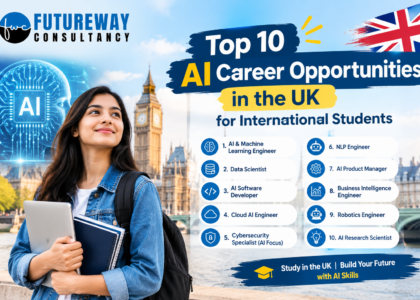
Read for Other Courses On UK : Top 10 AI Careers in the UK for International Students (2027 Guide)
Frequently Asked Questions
What is a masters in counselling psychology in the UK?
It is a postgraduate course, usually one year full time, covering counselling theory, therapy approaches, research methods and ethics. It builds knowledge and skills but does not by itself qualify you as a chartered counselling psychologist.
How long is a masters in counselling psychology in the UK?
Most are 12 months full time or about two years part time, depending on the university.
Can international students study counselling psychology in the UK?
Yes. International students can apply to UK universities and, if accepted, apply for a Student visa. Entry requirements, fees and English language scores vary by university.
Do I need a psychology degree to apply?
Not always. Some universities accept related degrees with relevant experience, but doctoral routes usually require GBC, which may need a conversion course.
How much does a masters in counselling psychology cost for international students?
Fees vary widely, often roughly £15,000 to £30,000 for the full course. Check each university’s current fee page and add living, visa and health surcharge costs.
What is the difference between counselling psychology and clinical psychology?
Counselling psychology emphasises the therapeutic relationship and wellbeing across settings. Clinical psychology focuses more on assessing and treating mental health conditions, often in NHS services. Both need doctoral-level training in the UK.
Can I work in the UK after my masters?
Eligible graduates may apply for the Graduate Route visa. Check the current duration and rules on gov.uk, as they have been under review.
Is a masters in counselling psychology worth it?
It can be, if you aim for doctoral training, therapy-related roles or mental health careers. If you only want to practise counselling, a BACP or UKCP accredited masters may be a more direct option.
Official Sources to Check Before You Apply
- British Psychological Society (BPS): accredited courses and GBC
- Health and Care Professions Council (HCPC): protected titles and registration
- BACP and UKCP: counselling and psychotherapy accreditation
- UK Government (gov.uk): Student visa and Graduate Route
- Each university’s course and fees page