Real Guidance. Real Support. A Successful Study Abroad Journey.
The best AI careers in the UK for international students are: Machine Learning Engineer, Data Scientist, AI Research Scientist, AI Product Manager, Data Engineer, NLP/LLM Engineer, Computer Vision Engineer, AI Ethics and Governance Specialist, MLOps/AI Infrastructure Engineer, and AI Consultant. London, Manchester, Edinburgh, Cambridge and Bristol are the main hubs. Most international graduates start on the Graduate Route visa and then move to a Skilled Worker visa with a licensed sponsor.
Why the UK Is a Strong Choice for AI Careers
The UK is one of Europe’s leading AI ecosystems. It has world-ranked universities (Oxford, Cambridge, Imperial, UCL, Edinburgh), a large fintech and healthtech sector, major AI labs and a growingT startup scene. Banks, the NHS, consultancies, retailers and public bodies are all hiring AI talent, so international students can find opportunities across many industries rather than only in “tech” companies.
At Futureway Consultancy, we help students choose the right AI course, university and career pathway. Below are the 10 roles we see offering the strongest prospects.
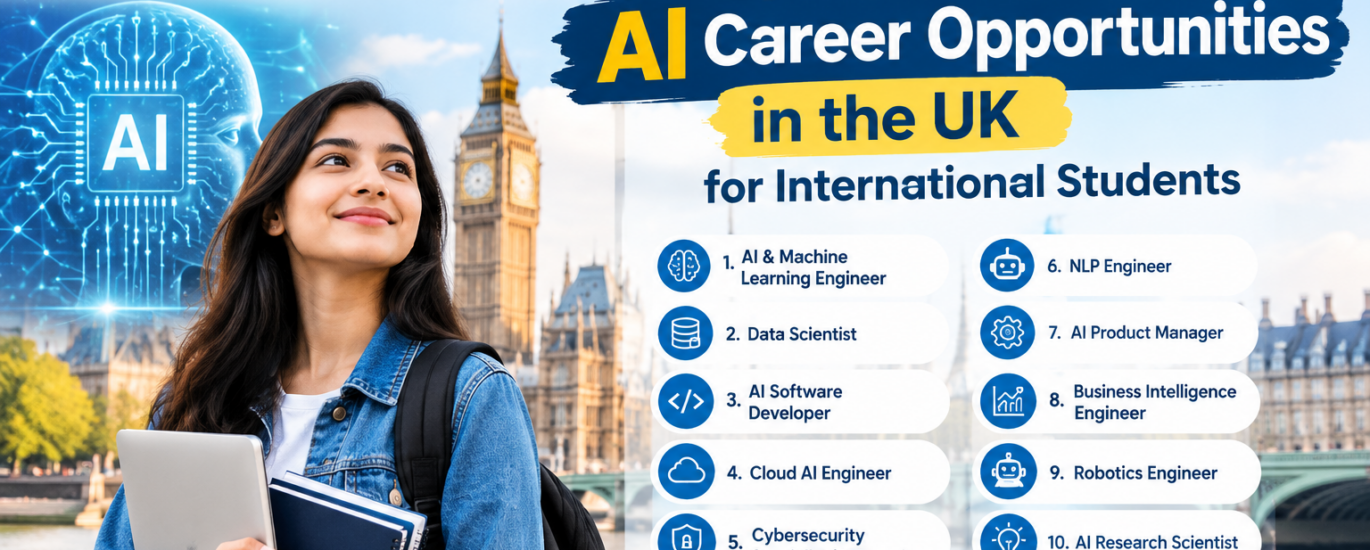
Top 10 AI Career Opportunities in the UK
Salary ranges below are indicative estimates that vary by city, employer and experience. Always check live job listings.
1. Machine Learning Engineer
What you do: Build, train and deploy models that power recommendations, fraud detection, forecasting and more.
Indicative salary: £40,000 to £80,000+
Key skills: Python, PyTorch/TensorFlow, SQL, cloud platforms (AWS, Azure, GCP)
Best for: Students with a computer science, maths or engineering background.
2. Data Scientist
What you do: Turn data into insight using statistics, modelling and visualisation to guide business decisions.
Indicative salary: £35,000 to £70,000
Key skills: Python/R, statistics, machine learning, data storytelling
Best for: Analytical thinkers from maths, economics, physics or business analytics.
3. AI Research Scientist
What you do: Develop new algorithms and push the boundaries of what AI can do, in industry labs or universities.
Indicative salary: £45,000 to £100,000+ (higher at top labs)
Key skills: Deep learning theory, research publication, advanced maths
Best for: MSc/PhD graduates who enjoy research.
4. NLP / Large Language Model (LLM) Engineer
What you do: Build chatbots, search tools, summarisation systems and generative AI applications.
Indicative salary: £45,000 to £90,000+
Key skills: Transformers, prompt engineering, retrieval-augmented generation (RAG), fine-tuning
Best for: Graduates interested in language, applied AI and fast-moving products.
5. Computer Vision Engineer
What you do: Teach machines to interpret images and video, for medical imaging, autonomous vehicles, retail and security.
Indicative salary: £42,000 to £85,000
Key skills: CNNs, OpenCV, PyTorch, image processing
Best for: Engineering and robotics graduates.
6. Data Engineer
What you do: Build the pipelines and platforms that feed AI systems with clean, reliable data.
Indicative salary: £38,000 to £75,000
Key skills: SQL, Spark, Airflow, cloud data warehouses
Best for: Students who like systems and software engineering. Demand is steady because every AI project depends on good data.
7. MLOps / AI Infrastructure Engineer
What you do: Deploy, monitor and scale machine learning models in production.
Indicative salary: £45,000 to £85,000
Key skills: Docker, Kubernetes, CI/CD, model monitoring
Best for: Graduates who combine DevOps and ML skills, a gap many UK employers struggle to fill.
8. AI Product Manager
What you do: Decide what AI products get built, balancing user needs, technical limits and business goals.
Indicative salary: £50,000 to £95,000
Key skills: Product strategy, stakeholder communication, AI literacy
Best for: Business, MBA and tech graduates with strong communication skills.
9. AI Ethics, Risk and Governance Specialist
What you do: Ensure AI systems are fair, transparent, safe and compliant with regulations such as UK GDPR and emerging AI rules.
Indicative salary: £40,000 to £80,000
Key skills: Data protection law, risk frameworks, policy analysis, technical understanding
Best for: Law, policy, social science and philosophy graduates who want an AI career without heavy coding.
10. AI Consultant / Business Analyst (AI-focused)
What you do: Help organisations in finance, healthcare, retail and the public sector adopt AI effectively.
Indicative salary: £38,000 to £75,000
Key skills: Problem-solving, client management, domain expertise, data literacy
Best for: Graduates who want variety and a strong route into leadership.

“As a Bangladeshi student, I found it difficult to choose the right country for my higher education. Comparing tuition fees, courses, and scholarship opportunities helped me understand which destination suited my goals and budget.”
Mr. Sharuz ( MA in UK)
UK Visa Pathways for AI Graduates
Graduate Route: This post-study visa lets you work or look for work without employer sponsorship. From 1 January 2027, the duration is announced to drop to 18 months, so check the current length on GOV.UK before you apply. study-abroad
Skilled Worker visa: This is the main route to longer-term work and settlement, and you need a job offer from a licensed sponsor. New entrants can be paid 70% of the going rate for their occupation, subject to a minimum of £33,400 a year, for up to 4 years, while the general threshold is £41,700. Your salary must meet whichever requirement applies to your job code. tarve
Other routes worth exploring: Global Talent (for exceptional talent and leadership in digital technology) and High Potential Individual (for graduates of top global universities).
Important: Immigration rules and salary thresholds change often. Always confirm current requirements on GOV.UK or with a qualified adviser before making decisions.
How to Build an AI Career in the UK: 6 Steps
- Choose the right course. Pick a UK MSc in AI, Data Science, Machine Learning, Computer Science or a related field with strong industry links and placement options.
- Build a portfolio. Publish projects on GitHub and enter Kaggle competitions. Employers value proof of skill.
- Gain UK experience. Apply for internships, placement years and university industry projects.
- Network early. Join UK AI meetups, LinkedIn communities and your university careers service.
- Target sponsor-licensed employers. Check the Home Office register of licensed sponsors before you apply.
- Plan your visa timeline. Start your job search in your first term, not after graduation.
Frequently Asked Questions
Which AI job is easiest to get as an international student in the UK?
Data Analyst, Data Engineer and Data Scientist roles usually have the largest number of openings. Specialist roles such as Research Scientist often require an MSc or PhD.
Can I work in AI in the UK without a coding background?
Yes. Roles in AI governance, product management, consulting and policy value domain expertise, though a basic understanding of data and AI is still expected.
Do I need a master’s degree to work in AI in the UK?
Not always, but many AI-specific roles prefer an MSc or higher, especially in research and machine learning engineering.
Which UK cities have the most AI jobs?
London has the largest concentration. Cambridge, Oxford, Edinburgh, Manchester, Bristol and Leeds also have strong AI and data sectors.
Can I switch from the Graduate Route to a Skilled Worker visa?
Yes, if you have a job offer from a licensed sponsor that meets the salary and eligibility requirements. Switch before your Graduate visa expires.
Does the Graduate Route count towards settlement?
No. Time on the Graduate Route does not count towards the five-year settlement period, while time on a Skilled Worker visa does.